

Quick Links
Frequencies | Countries | Lingo | Q-Code | Number Signals | Slang & Jargon | Links | Retailers | Advice | Shops
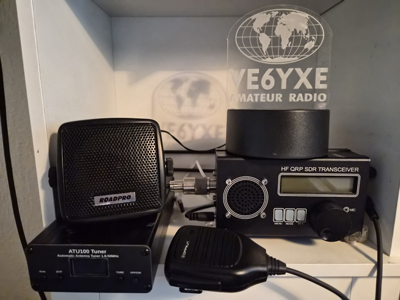
Amateur Radio or as it is often called, Ham Radio.
The term "ham" was likely used during the 19th century, to mock operators with poor Morse code-sending skills ("ham-fisted"). This term continued to be used after the invention of radio, and the increase of amateurs experimenting with wireless telegraph. Land and sea-based professional radio telegraphers considered "hams" a nuisance.
The use of "ham" meaning "amateurish or unskilled" survives today, perhaps in the artistic realm ( ham actor ). Amateurs reclaimed the word and by the mid-20th century it had lost its original meaning.
Amateur radio is represented by the International Amateur Radio Union (IARU), which has three regions and includes national amateur radio societies in most countries.
In 2011 the American Radio Relay League (the U.S. national society) estimated that about 2 million people worldwide were active in amateur radio.
About 830,000 amateur radio stations are in Region 2 (the Americas), about 750,000 in Region 3 (South and East Asia and the Pacific), and about 400,000 in Region 1 (Europe, the Middle East, the CIS and Africa).
Radio amateurs have been credited with a number of advancements, notably the discovery of skywave propagation.
By 2025, the number of licensed amateurs rose to 3 million, with the US at 750,000, Japan at 382,000 and China near 250,000. UK at 86,000 and Canada at 71,000 round out the top 5.
Source : Amateur Radio Operators by Country 2026
Contact me through my call-sign email address: ve6yxe@gmail.com
Visit my QRZ page: https://www.qrz.com/db/VE6YXE
The International Telecommunication Union (ITU) governs the allocation of communications frequencies worldwide, with participation by each nation's communications regulation authority.
National communications regulators may restrict access to band frequencies or to award additional allocations as long as radio services in other countries do not suffer interference.
In some countries, specific emission types are restricted to certain parts of the radio spectrum, and in most other countries, International Amateur Radio Union (IARU) member societies adopt voluntary plans to ensure the most effective use of spectrum.
Many countries have classifications based an individual’s proficiency (Theory, Electronics) and others by national standards.
Depending on proficiency, many amateurs may build radio transceivers, power supplies, amplifiers and antenna(s).
Amateurs may transmit Data, Voice, Morse Code, Text, TV images (specialty), Internet, Satellite and where available over cellular telephone.
Call Signs determine country, province or state, region or area of the world. Amateurs are assigned call signs based on their geographic location.
Click the hyperlink to view. http://www.on4sh.be/ham/prefix.htm
Example: Canadian amateur stations begin with VE, VO, VA or VY followed by a number that designates the province or territory and followed by a two or three letter suffix.
Special event call signs may start with C or X (or other, depending on circumstances)
United States amateur stations begin with W, K, N or A followed by a digit (0-9) indicating the call region, and a 1-3 letter suffix. Standard prefixes include K, N, W, AA-AK, KA-KZ, NA-NZ, and WA-WZ.
Note, US Amateurs may choose specific or vanity call signs (where available)
For more on where you can gain information on requirements, licensing and examinations in your area, contact your government radio licensing agency.
In Canada, https://www.rac.ca
In the USA, https://www.arrl.org
In the UK https://rsgb.org
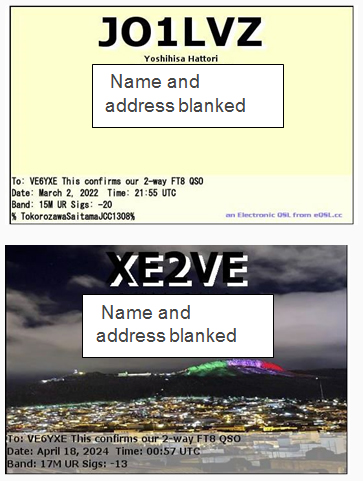
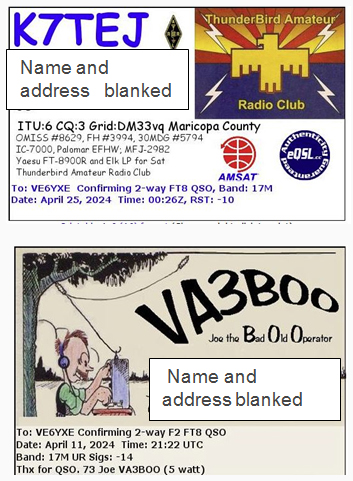
**NOTE: Many amateurs subscribe to more than one electronic QSL platforms. Others still prefer the traditional format of mail ( in exchange for return postage in US or local currency ), although this has mostly stopped because of theft by non-recipients.
Q codes and Numbers shorthand often play a large part in shortening an otherwise lengthy conversation in emergency situations for example.
ITU Alphabet codes are primarily using in CW (Continuous Wave ) or simply Morse Code.
Each letter and number are a special word pronunciation to help eliminate mis-heard words, or words that sound the same.
While primarily in English, the ITU alphabet is used worldwide.
Example: A = Alfa, B= Bravo, Q = Quebec, Y = Yankee.
Numbers also have a specific pronunciation.
Example: 1 = Wun, 4 = FoWer, 9 = Niner.
Original Q-signals were created in the early 1900s by the British Postmaster General for use by British ships and coast stations. They proved to be so useful, however, that radio operators worldwide began using them.
One reason they proved to be so useful is that they can even be used by operators speaking different languages.
When an English-speaking operator receives QTH? they understand it to mean, “What is your location?” A Slovak-speaking operator will translate that to, “Aká je tvoja poloha?” while a German-speaking operator will hear, “Wo befinden Sie sich?”
Many Q signals are no longer used due to the change in technology.
In everyday conversations, we use slang terms.
Some might only be known by a select group, while others are becoming commonplace, such as LOL, and WTF.
So it is with amateur radio.
Examples:
Many are simple, many are fancy. See pictures below.
DIY, Operating, Hints and Kinks, Retailers, Swap and Shop
DIY Antenna design: www.hamradiorookie.com
Operating Hints, Parks (POTA), Outings info@outnaboot.ca
There are amateur radio stores across Canada, and in other countries , that sell new radios, antennas, accessories and operating aids.
It would be impossible to list every one.
Best to search the internet for a store near you.
Yes . . . you can buy amateur equipment on-line at the giant retail outlets.
They are in many cases, less expensive at a quick glance. You must take into account the shipping costs, import fees etc.
It’s always a good idea to research local (or at least your country) dealers or representatives in case of . . . how do you return a non-working piece to another country?
Chances are you pay, and wait, and maybe you’ll get a refund.
I’m not suggesting their equipment isn’t quality merchandise, only that there are a myriad of clones, knock-offs, and similar gear.
I’ve bought lots, good and bad.
Much like all specialty items, do your homework before you click “BUY”.
A quick note . . . ask yourself what you want to do with your equipment. Then decide what type of equipment you’ll need.
- Emergencies, or communications while travelling.
- Digital signals. Talk to the International Space Station.
- Search long distance stations (DX)
- Work from a mountain top (SOTA-summits on the air)
- Work from a park (POTA-parks on the air)
Don’t get starry eyed with all the buttons, and colour screens and built-in nice-to-haves.
Avoid being mesmerized by thousand dollar outfits, kilowatt power amplifiers that can cook hotdogs, and huge antenna arrays.
Check your municipal bylaws for restrictions on antenna heights.
Lots of bargains and unique finds at www.hamshack.ca
Many local amateur radio clubs have a website with listing for used equipment for sale.
Social media sites also have links to buyers and seller. Be wise and do your homework.